
When a farmer in Bafoussam sells a harvest, how long does that money circulate in the region before it leaves to pay for imports? Often, not long at all. That question led me to write a white paper on local and complementary currencies (LCCs) to support « Made in Cameroon ».
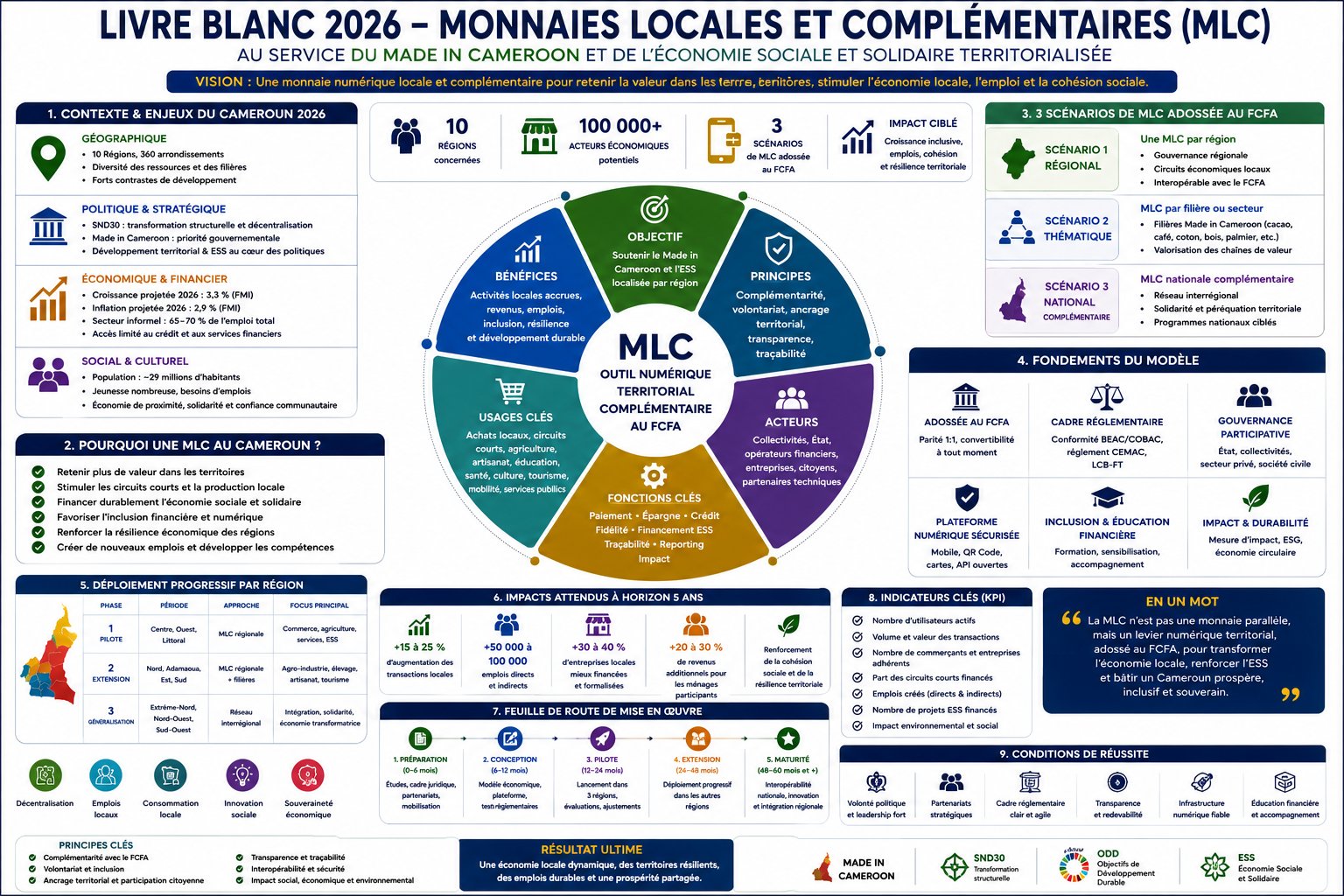
The situation
Cameroon in 2026 combines moderate growth (3.3% according to the IMF), heavy dependence on imports and an informal sector that employs the vast majority of workers. Fewer than 20% of people have a bank account in the strict sense, but more than half use mobile money. The lever exists: it should be used to keep value in the regions.
An LCC is not a rival currency
The BEAC holds the monopoly on issuing the CFA franc. The white paper therefore does not propose a new currency, but a digital instrument backed by the CFA franc (1:1 parity, convertible), legally structured as a value voucher or mutual credit system. Its purpose is to boost local purchasing, regional value chains and the social and solidarity economy.
Three scenarios, one pilot
- Regional: one LCC per region, managed locally.
- Sector-based: one LCC per Made in Cameroon value chain (cocoa, coffee, cotton, timber, palm).
- National complementary: an inter-regional network with territorial equalisation.
Deployment relies on existing mobile money rails (USSD, QR codes) and on regional cooperative governance. It draws on proven schemes: the Swiss WIR, Banco Palmas in Brazil, Sardex in Italy, the Eusko in the Basque Country and Sarafu in Kenya. The 2026-2030 roadmap plans a pilot in two regions before any extension.
Conditional feasibility
My conclusion is cautious: the lever is real, under three conditions. A legal design that respects the BEAC/COBAC framework, technical integration with existing payment platforms, and transparent governance involving local authorities, businesses, financial operators and citizens.